Updated January 2013
This page was originally created in 2008, when I purchased my first LED light bulbs. Since then I've periodically updated it with new data. These results are from early 2013. Earlier results can be seen below - they are most likely no longer of relevance for most people, as the technology has moved on, but I leave them for historical purposes.
The Bulbs:
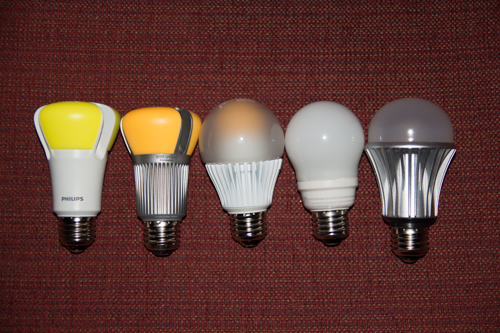
From left to right, three Philips LED bulbs. The L Prize winning bulb is on the far left, followed by their 12w bulb, and their 8w bulb. Then a random CFL (NuVision, a big box generic bulb), and a random LED (Utilitech 7.5w, another big box generic bulb).
Comparing the L-Prize bulb to the 'Endura LED' bulb (the Philips 12w), the specs say the new bulb should be 2w less energy and 140 lumens brighter (about 18 percent).
Survey says:

Too close to call. Grabbing a much closer section of the photo


it's still very hard. Flipping quickly between them it is clear that the L-Prize bulb is brighter, but it's obviously subtle.
The difference between the two in wattage is not. The L-Prize bulb, as measured by my Kill-A-Watt, is drawing 7 watts. The other bulb, 11 watts. So in this case the L-Prize bulb totally dominates.
A side note - the average price of electricity is approximately 13 cents per KWH. The L-Prize bulb will use 10.23 KWH in a year (4hrs/day). Or about $1.33 / year. The other bulb will use 16.07 KWH, or $2.09. Save about 70 cents a year.
The next bulb (Philips 409938 EnduraLED Light Bulb) is interesting, in that it draws exactly the same amount of energy as the L-Prize bulb, and is from the same manufacturer.
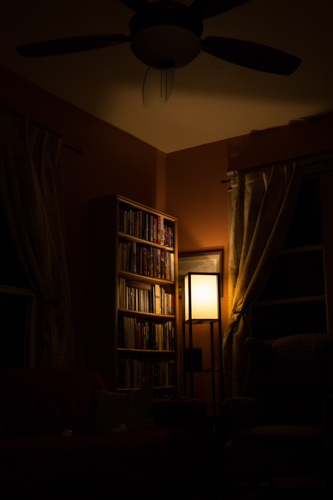
This one is quite a bit darker. According the the box, it's half as bright, however, I'm not sure I believe that this particular sample is that way. Nevertheless, the power to light ratio is quite obviously in favor of the L-Prize light.
So now let's look at a CFL. It draws 8w, so a bit more than the L-Prize bulb. How does it look?
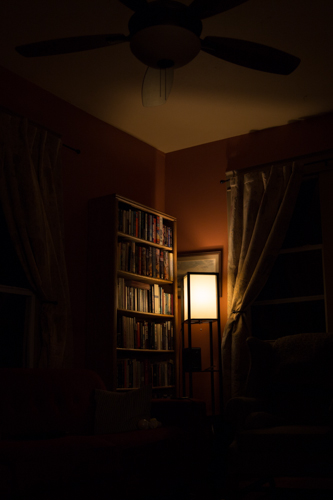
Looking closer, it becomes very clear

One of the most striking things about running this comparison this year was how good everything, even the CFL, was. The LED bulbs have completely come into their own, and with 60w incandescent equivalent bulbs now being available (and more importantly actually equivalent), there's no compromise involved in going LED. The cost is still a bit steep - my L-Prize lights were $33. Most of the other LED lights were around $25 at the time I bought them. Ignoring the wasted energy, and the mercury, it's not clear to me that LEDs have a price advantage over CFLs yet. But I suspect by this time in 2014 that will no longer be true. And it's awful nice not to call a hazmat team when you break a lightbulb.
End of 2013 results
Begin older data
(Updated July 2010 with additional data. See below 2008 results or click here)
In May of 2008 I purchased my first LED lightbulb, a
Westinghouse Nanolux 1W White LED
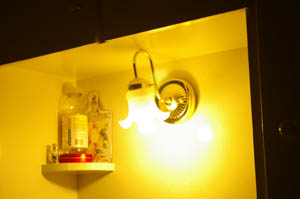
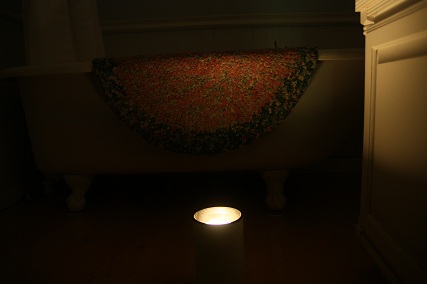
Below you can see the photos taken of each bulb.
The least bright is the LED bulb, followed by two CFL bulbs, a GE 10 Watt (40 Watt equivalent) Energy Smart Soft White Spiral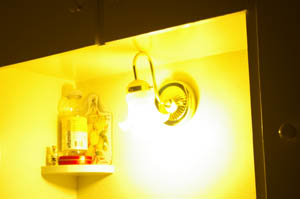
and a
Feit Electric 18-Watt Compact Fluorescent Mini Twist Bulb (75-Watt Incandescent Equivalent), Daylight. As it turned out,
the comparison isn't really fair - the LED bulb is pulling 0.03 amps, one quarter
of the 0.12 amps the GE CFL is pulling. The Feit CFL is
pulling 0.20 amps, which is almost twice the electricity of the GE CFL.
So for the moment, a very inconclusive result. I clearly need to buy a bigger LED bulb. I do begin to suspect that the claims of efficiency of LEDs over CFLs are, at least in 2008, not true. But higher efficiency LEDs are always coming down the pipe and the mercury problem with CFLs isn't going away.
Using the same methodology, I tested 5 additional bulbs - 2 CFLs and 3 LED bulbs. I purchased both of my larger bulbs at Home Depot, in part because it's easy, in part because I want to support the sale of LED bulbs at mass-market places, and in part because it's easy, and easy to return if something is wrong (so far, so good on that end of things!)
An old CFL that happened to be in the fixture I wanted to use. It consumed 16w and was much brighter than any of the other bulbs. I believe it is a 75w equivalent.
This is an EcoSmart 40w equivalent bulb, which claims on the box to use 8.6w and produce 429 lumens of light. If my Kill-A-Watt is to be trusted, it used 6w.
This is an old (~1-2 years) CFL I had in my kitchen. It used 8 watts, and is noticably less bright than the LED bulb, although it looks like the LED bulb doesn't have as wide a throw radius. This is a problem with LED bulbs - they can be too directional.
A Sylvania 8 watt LED bulb, which only consumed 6 watts measured. This light does not appear to have as narrow a throw as the EcoSmart bulb, and seems to be brighter as well.
A Westinghouse Nanolux 3-Watt Bulb, which interestingly only consumed 2 watts.
Conclusion: Right now, it looks like LEDs are definitely more efficient - if I had to guess, looking at the Sylvania and my old CFL, I would say better than 25 percent more efficient. The price point is tricky - the DOE (United States Department of Energy) estimates that around 15 percent of your total energy use is from lighting. Over the long haul, you should therefore make back the price difference. A quick calculation - my LED bulb claims to last 50K hours. Times 6w is 300KWH, times 10 cents/KWH = 30 dollars over its lifetime. The 8w CFL, which produces less light, will cost 40 dollars, plus the cost of replacing it 3 times (a CFL from the same maker claims 15K hours). So it might be a wash in terms of cost, but you will have less light, and apparently, less light over time - I have read that CFLs become less bright over their lifespan (which makes me wonder about using old bulbs for this test).
If the lifespan of LEDs holds out (I've yet to lose one, so can't comment), the initial capital outlay should make them a good buy. And either way, you get to use less electricity, which is always nice!
Disclaimer: Purchases made through Amazon result in me receiving a small payment (in theory - they've never actually sent me a check, but the possibility exists that they will someday).
LED lightbulbs versus CFL lightbulbs <- technology <- Home